
Why Carrier-Board Module-Current Measurements Can Be Misleading
Off-state current attribution at the supply header of two off-the-shelf cellular carrier boards
0.000 mA
BG95-M3 Off-State Header Current
≈0×
BG95-M3 vs Power-Off Leakage
≥0×
SIM7080G vs Power-Off Maximum
- Primary Instrument
- Nordic Power Profiler Kit II, 100 kS/s
- Boards Evaluated
- DIP40CORE-A (Quectel BG95-M3), Waveshare SIM7080G Cat-M/NB-IoT HAT (SIMCom SIM7080G)
- Constraint
- No hardware modification
- Raw Recordings
- Zenodo, doi:10.5281/zenodo.23399520
- Engineering Readiness Outcome
- Module-level off-state current not attributable at the supply header of either board
Assessment
A current measurement at a cellular carrier board's supply header records the current entering the board through that point. Where the module shares that supply path with other loads, the reading includes their consumption.
ERS-2026-003 examines two off-the-shelf carrier boards from different vendors, carrying modules from two manufacturers, with the same instrument and no hardware modification. It asks whether supply-header current can be attributed to the module alone, and defines a procedure for assessing attribution before a header reading is reported as module current.
Sleep and Power Saving Mode current were not measured, and no energy-consumption result is reported.
Engineering Findings
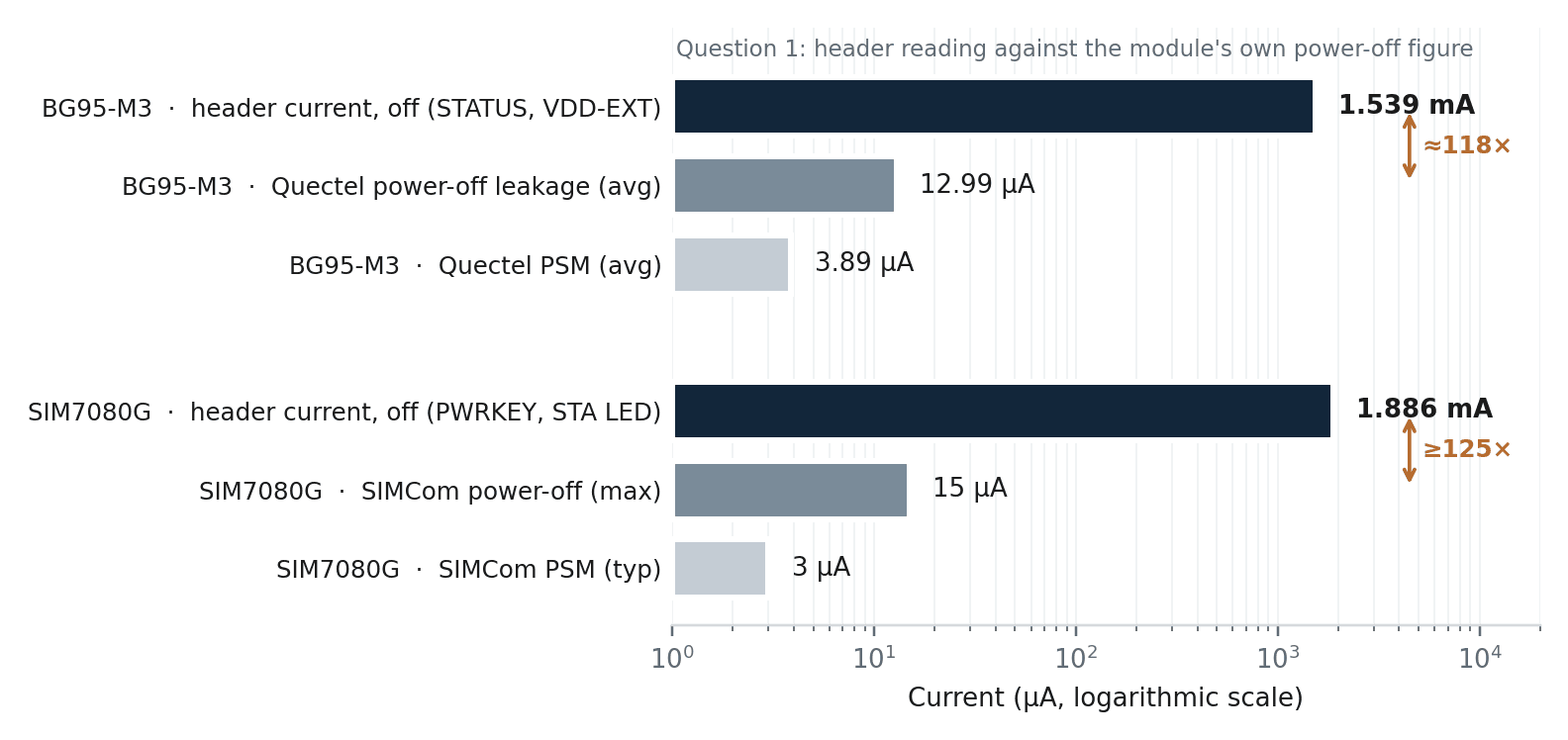
- 1DIP40CORE-A (Quectel BG95-M3). With the module confirmed off by its STATUS and VDD-EXT outputs, the supply header drew 1.539 mA over a 30-minute capture, about 118 times Quectel's published BG95-series power-off leakage figure of 12.99 µA (Quectel publishes no separate LA-variant figure). The result reproduced the earlier 1.53 mA measurement within 0.6 %, and a module-side UART disconnection changed the mean by less than 0.13 %.
- 2Waveshare HAT (SIMCom SIM7080G). Re-measured at 3,800 mV in two 5-minute recordings, the module stayed off after the supply was applied, was started with PWRKEY and was then powered down with PWRKEY. After power-down the supply header drew 1.886 mA, at least 125 times SIMCom's published maximum power-off current of 15 µA, and within 0.6 % of its level before the module was first switched on in both recordings.
- 3Board-level paths. On the SIM7080G board, the schematic places an always-on power LED on the shared VBAT net. On the BG95-M3 board, two resistive paths account for an estimated 0.3 to 0.4 mA, and the on-board regulator's unconnected input was back-powered from the supply rail to 3.33 V. The current through that path was not measured, so the remaining current has not been accounted for.
- 4Attribution outcome. Module-level current could not be isolated at the header of either board. The results do not establish a board fault; they show that a header measurement includes board-level paths.
Evidence Basis
- Instrument: Power Profiler Kit II checked at three points with deviations below 1 %; the off-state operating points (source meter, 1.5 to 1.9 mA) were not separately checked.
- Module state: STATUS and VDD-EXT outputs read independently of the current reading, with an AT-interface cross-check (BG95-M3). PWRKEY power-down with the STA LED dark when off and lit when on, STATUS not metered (SIM7080G).
- Raw data: a 30-minute off-state recording and a 5-minute UART disconnection recording (BG95-M3), and two 5-minute recordings at 3.8 V (SIM7080G), analysed from the raw samples.
- Topology: vendor schematics for both boards, with every other source and sink on the shared supply net identified.
- Comparators: module manufacturers' hardware design documents, cited by version, table and statistic.
- Reproducibility: raw recordings, analysis scripts and SHA-256 values published in the supporting repository and Zenodo dataset.
Procedure
- Cite the module manufacturer's power-off, PSM and sleep figures by document version, table and statistic.
- Establish supply topology from the board schematic, and identify every other source or sink on a shared node.
- Establish module state from signals independent of the current reading.
- Measure off-state header current at the specified supply voltage for at least 10 minutes, hands off, and analyse the raw recording.
- Compare like with like. If the ratio to the module figure is much greater than one, report at system level.
Engineering Decision
Following independent engineering evaluation, Radianode considers that a supply-header reading on an off-the-shelf cellular carrier board should not be reported as module current unless three conditions are met and recorded: the off-state header current has been compared, like for like, with the module manufacturer's published off-state figure; module state was established independently of the current reading; and results are labelled at the attribution level they support.
System-level header-current measurements remain available on both boards. Module-level attribution requires a board that exposes the module supply in series, or a modification that this assessment's constraint excludes. On the DIP40CORE-A, a header measurement in network-confirmed PSM is the recommended next step.
Does not evaluate
- Sleep, PSM or eDRX current under a live network
- Any board other than the two evaluated
- Statistical behaviour across multiple units of either module
- The share of each board-level consumer on either board
- Any modified board, or any energy consumption result
- Temperature dependence
ERS-2026-003 · Version 1.0 · October 2026 · 25 pages
Publication Details
- Report
- ERS-2026-003 · Radianode Engineering Readiness Series
- Author
- Oluwanifemi A. Ogunjemilua · ORCID
- Issued by
- Radianode Ltd
Related Publications
Radianode provides independent engineering validation for connected and wireless systems. If a current or battery-life figure in your design rests on a header reading, talk to an engineer.