
Measurement Chain Readiness for Instrument-Grade Energy Characterisation of Cellular IoT Devices
An independent assessment of whether a laboratory measurement chain is fit to produce defensible instrument-grade energy measurements of cellular IoT devices. No energy consumption result is reported — the subject is the instrument, not the device.
0.00%
Current Measurement Deviation
0.00 dB
RF Branch Imbalance
~0×
Attribution Boundary
- Measurement Instruments
- Nordic PPK2, Anritsu MS2712E, HP 6611C, Keysight DSOX1102G
- Device Under Test
- Waveshare SIM7080G Cat-M/NB-IoT HAT
- Network Emulation
- Amarisoft Callbox, Band 25 FDD
- RF Network
- 20 dB / 30 dB attenuators, Wilkinson divider
- Engineering Readiness Outcome
- Ready for system-level energy measurement
Assessment
Before energy consumption can be measured defensibly, the measurement chain itself must be shown to produce trustworthy electrical measurements under controlled cellular network conditions.
ERS-2026-002 evaluates the readiness of a laboratory measurement chain for cellular IoT energy characterisation. The assessment covers the electrical current-measurement path, RF attenuation and combining, link-level repeatability, and the highest current-attribution level supported by the evaluated carrier board's access point.
The assessment does not report a device energy-consumption result. Instead, it establishes what the measurement chain can reliably measure, under which conditions, and where its attribution boundary lies.
Engineering Findings
- 1Current measurement agreement. Independent reference measurements showed agreement between the evaluated current-measurement paths, with deviations of 0.55% in source-meter mode and 0.22% in ampere-meter mode against an independently derived reference.
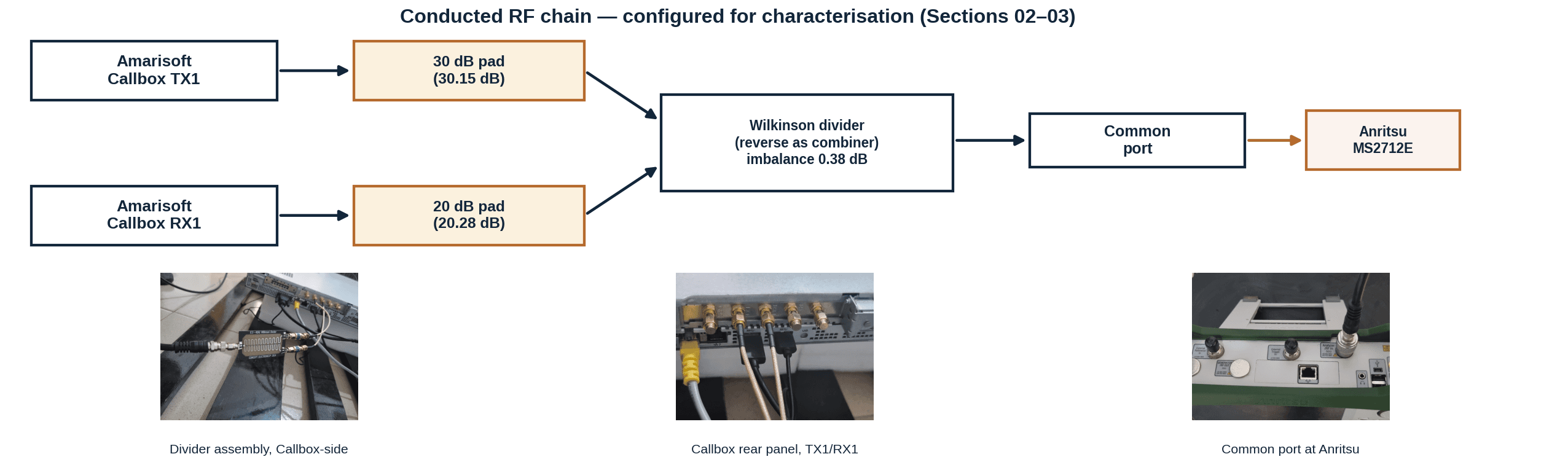
- 2RF chain characterisation. The evaluated 20 dB and 30 dB attenuators measured within 0.28 dB and 0.15 dB of nominal respectively, at the operating frequency. The Wilkinson divider used as a combiner showed a branch imbalance of 0.38 dB, with no measurable inter-port leakage above the measurement floor.
- 3Link-level repeatability. Absolute RF level was not shown to be reproducible between sessions from configuration alone. In-session verification against a calibrated instrument is required before every measurement.
- 4Attribution boundary. The evaluated carrier board does not provide a defensible module-only current measurement point under the applied no-modification constraint. Carrier-board (system) level attribution is the highest level supported by the evaluated access point.
Evidence Basis
- Electrical measurement: independent reference-load measurement and cross-checking of the evaluated current-measurement paths.
- RF network: characterisation of attenuation, combining and branch balance across the evaluated RF chain.
- Cellular conditions: controlled Band 25 FDD network emulation using the Amarisoft Callbox.
- Repeatability: cross-session RF level comparison, establishing the need for in-session verification.
- Attribution: assessment of the available current-access topology and its implications for module-level measurement.
Engineering Decision
Ready for system-level energy measurement. Following independent engineering evaluation, the measurement chain is considered fit to produce defensible energy measurements of cellular IoT devices at system level, subject to in-session verification of link level against a calibrated instrument and to measurements being reported at the attribution level they support.
Module-level energy attribution was not established under the no-modification constraint applied in this assessment. It requires a carrier board that exposes the module supply rail in series, or a modification to the evaluated board that this assessment's constraint excluded.
Does not evaluate
- Frequency response across the operating band
- Any energy consumption result for any device
- Any device performance, battery life or deployment claim
- Thermal effects and long-term instrument drift
- Carrier boards other than the one evaluated
- Radiated measurement of any kind
Publication Details
- Report
- ERS-2026-002 · Radianode Engineering Readiness Series
- Author
- Oluwanifemi A. Ogunjemilua · ORCID
- Issued by
- Radianode Ltd
Related Publications
Radianode provides independent engineering validation for connected and wireless systems. If your energy measurement results depend on the instrument chain behind them, talk to an engineer.