
Engineering Insights
Explore Engineering Insights
Featured Engineering Publication
Why Carrier-Board Module-Current Measurements Can Be Misleading
Can a carrier board's supply-header reading be treated as module current? On two off-the-shelf cellular boards, it could not.
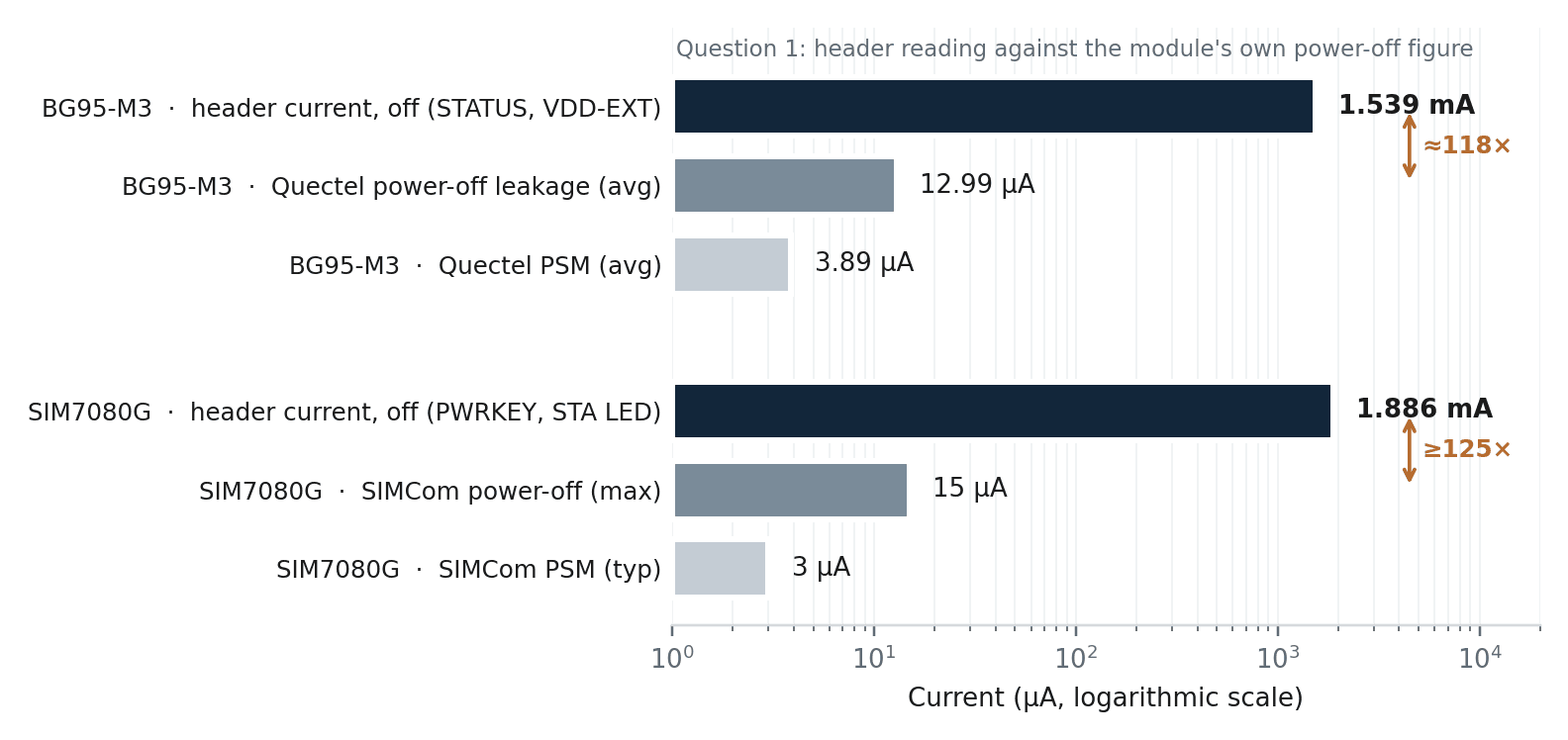
With the module off, the supply header of a BG95-M3 carrier board drew 1.539 mA, about 118 times Quectel's published BG95-series power-off leakage figure of 12.99 µA. A SIM7080G carrier board, powered down by PWRKEY at 3.8 V, drew 1.886 mA, at least 125 times SIMCom's maximum power-off current of 15 µA.
0.000 mA
BG95-M3 Off-State Header Current
≈0×
BG95-M3 vs Power-Off Leakage
≥0×
SIM7080G vs Power-Off Maximum
- Primary Instrument
- Nordic Power Profiler Kit II, 100 kS/s
- Boards Evaluated
- DIP40CORE-A (Quectel BG95-M3), Waveshare SIM7080G Cat-M/NB-IoT HAT (SIMCom SIM7080G)
- Constraint
- No hardware modification
- Raw Recordings
- Zenodo, doi:10.5281/zenodo.23399520
- Engineering Readiness Outcome
- Module-level off-state current not attributable at the supply header of either board
Does not evaluate
- Sleep, PSM or eDRX current under a live network
- Any board other than the two evaluated
- Statistical behaviour across multiple units of either module
- The share of each board-level consumer on either board
- Any modified board, or any energy consumption result
- Temperature dependence
Version 1.0 · October 2026 · 25 pages
Engineering Publications
Selected Engineering Work
Technical studies and briefs developed from Radianode's engineering work.
INT8 Post-Training Quantization for Seq2Point NILM on Resource-Constrained Edge Platforms
Measuring Energy in Cellular IoT Devices
Measurement Chain Readiness for Instrument-Grade Energy Characterisation of Cellular IoT Devices
Why Carrier-Board Module-Current Measurements Can Be Misleading