
Measuring Energy in Cellular IoT Devices
Why bench instrumentation and network emulation must be combined
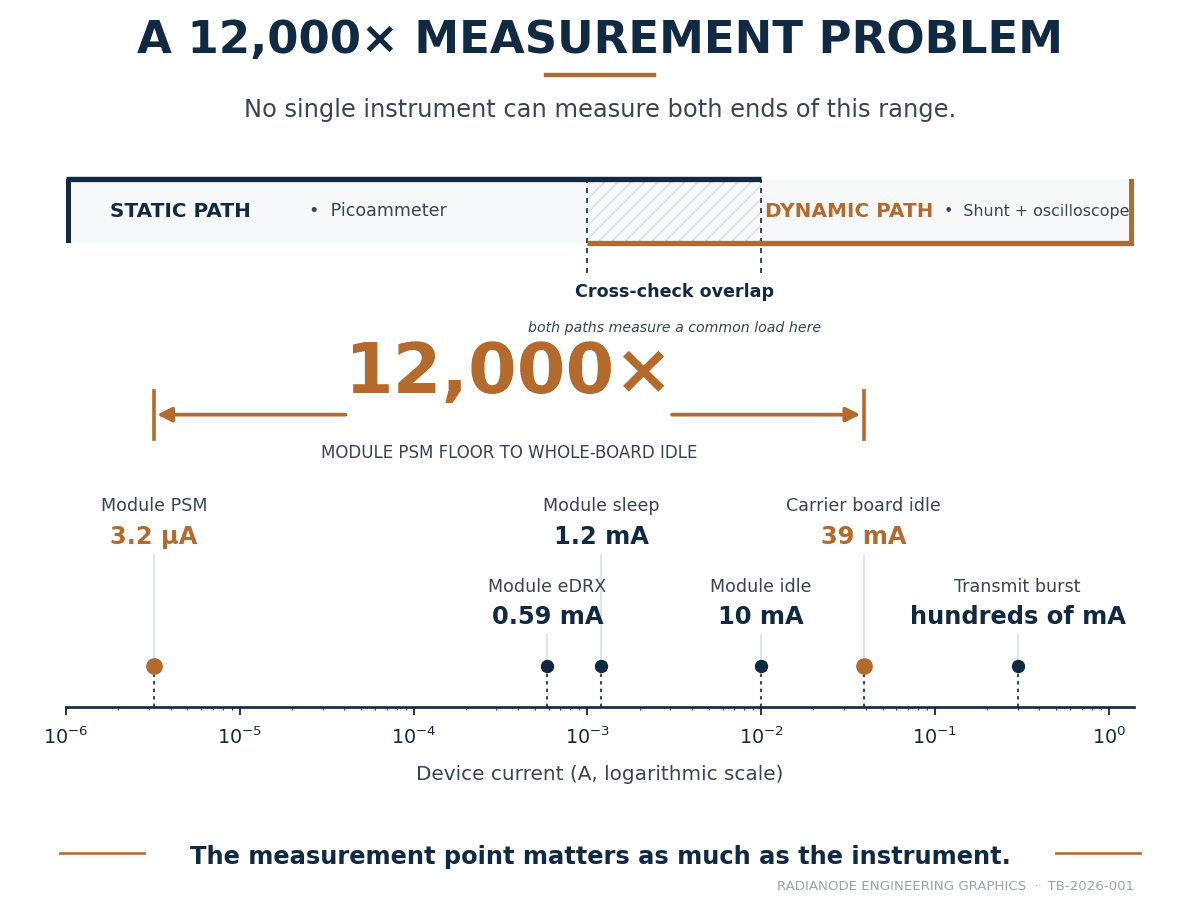
A cellular module with a sleep current of 3.2 µA can sit on a carrier board that draws 39 mA doing nothing. Both values come from the vendor. Both are correct. The difference is more than 12,000×. Yet neither value tells you what the complete assembly draws while the module sleeps, and that is the current that actually matters for battery life.
That gap is one of four reasons datasheet values alone cannot settle a question connected-device teams often face: should a battery-powered device run inference locally and transmit a result, or transmit raw data and infer elsewhere?
TB-2026-001 sets out what a measurement environment has to provide before that question can be answered from measurement rather than assumption. It reports no results. That was deliberate. Those follow through the Engineering Readiness Series.
Why datasheet figures cannot answer the question
Module datasheets publish current per operating mode. Those figures are accurate, and they are not the numbers the decision needs.
Transmit current assumes a link condition that is never stated. Uplink power is derived from network-configured parameters and the device's own path-loss estimate, and in poor coverage it can saturate at the configured maximum. For NPUSCH transmissions, when the number of repetitions of the allocated resource units exceeds two, transmit power is set to the configured maximum; below that threshold, the open-loop calculation remains bounded by that maximum. NB-IoT and Cat-M1 extend coverage by repeating transmissions, so the energy cost of a message is a property of the message and the link condition together, not of the message alone. For small payloads, connection establishment and the release tail can cost more than the payload itself. And the current range across a reporting event can span five orders of magnitude, with the sleep floor dominating the budget for a device reporting once an hour.
A three-month field study of thirty NB-IoT nodes across more than twelve hundred locations found energy consumption imbalanced by up to 75:1 between nodes running the same workload, attributed to differing coverage levels, long-tail power profiles and excessive control-message repetition. [source]
Why existing measurement approaches fall short
Cellular energy metrology measures module current against a base station emulator. The network is controlled; there is no compute workload.
Edge inference metrology measures per-inference energy using shunt isolation and GPIO triggers. The compute is rigorous; there is no network.
Live-network measurement captures both, but the measuring party controls neither the propagation environment nor the operator's power-saving timers. A result from Tuesday afternoon cannot be reproduced on Wednesday morning, or by anyone else anywhere else.
What a sufficient measurement environment requires
- 1A conducted RF chain. Coaxial connection through calibrated attenuators, no antenna fitted. This makes coverage a commanded variable rather than an observed condition, which is what makes a result reproducible by a third party.
- 2A controlled radio access network. PSM timers, eDRX cycle and paging time window, and connected-mode DRX become settings rather than inheritances.
- 3Dual-path current measurement. No single instrument spans a sub-microamp sleep floor and a transmit burst of hundreds of milliamps. Eight-bit acquisition on the dynamic path cannot represent a microamp floor at all, and higher resolution does not close the gap: at 12 bits the step is still more than twenty-five times the module sleep floor.
- 4Phase-resolved attribution. Energy decomposed into wake, pre-processing, inference, connection establishment, uplink, downlink, release tail and return to sleep, so a result says where the energy went and not merely how much.
What becomes answerable
- At what reporting interval local processing beats offloading
- How that boundary moves as coverage degrades
- Whether model precision shifts it by more than measurement uncertainty
- Whether the power-saving configuration changes which strategy wins
- Whether coincident transmit and compute bursts pull the supply below the module's operating margin
What this methodology does not answer
The brief states its own limits in a dedicated section. No real propagation. No operator-specific network behaviour. No cross-vendor generalization from a single module. No substitute for field trials.
A method described without its limits is marketing.
Where this matters
The methodology is most valuable before hardware is committed, when the architecture decision is still open and changing it is a design review rather than a product recall.
It can be applied to selecting between local processing and offloading, validating published energy figures against a device's actual duty cycle, and investigating transmission-related power behaviour that cannot be reproduced reliably on a conventional bench.
Publication Details
- Report
- TB-2026-001 · Radianode Technical Brief Series
- Author
- Oluwanifemi A. Ogunjemilua · ORCID
- Issued by
- Radianode Ltd
Related Publications
Radianode provides independent validation for connected, wireless and embedded systems. If you are making an architecture decision that rests on a battery life claim, talk to an engineer.